ACe up your Sleeve: NLR’s Revamped Air Conditioning
In the heat of the moment, we typically don’t think about our air conditioning — until we see the electricity bill. While air conditioning has radically improved our comfort, the technology is still outdated and expensive. Every year, air conditioners cost Americans more than $29 billion in household energy costs, and by 2050, global air-conditioning use is expected to climb to five times what it is today.
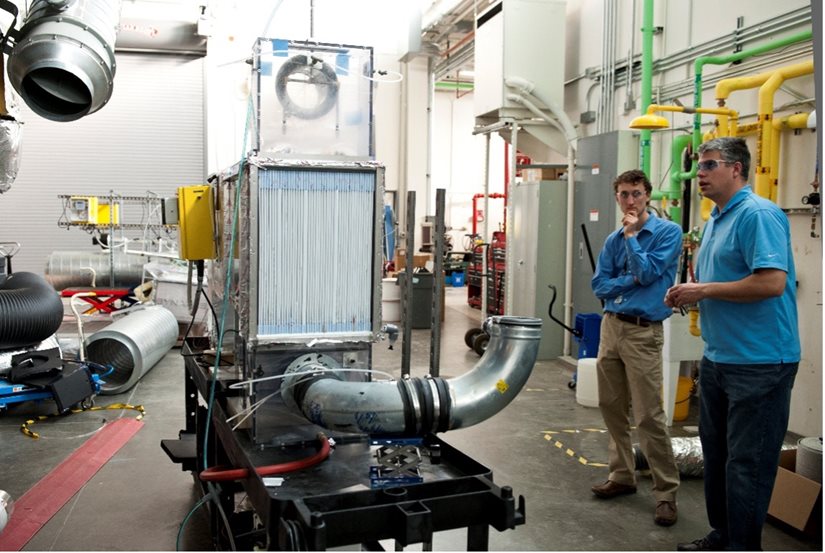
To meet this demand, scientists at the National Laboratory of the Rockies (NLR) designed an air conditioning system that can store and release energy with peak efficiency. The Energy Storing and Efficient Air Conditioner (ESEAC) uses a liquid desiccant, which requires significantly less energy than conventional dehumidifcation processes, helping reduce operating costs. The desiccants work like a sponge for the air conditioning system, by drawing out moisture from the air. Because dry air requires less energy to cool, this makes the process faster and more affordable.
In addition, ESEAC incorporates built-in energy storage, allowing it to consume far less electricity from the grid during peak times. In other words, the ESEAC combines cooling, dehumidification, and energy storage into one efficient system – creating the perfect storm for air conditioning! ESEAC could lower electricity bills for cooling by more than 45% and reduce peak demand by more than 90%.
Like the ESEAC’s multi-faceted parts, the technology transfer consisted of thorough collaboration between federal researchers, licensing professionals, private entrepreneurs, and corporate partners. In 2018, NLR and the startup Blue Frontier pursued a license agreement with key milestones tied to capital raising, prototype development, and manufacturing obligations.
The license was amended five times to accommodate the company’s growth, and 22 patents were secured with nearly $3 million in joint project funding. Two years in, Blue Frontier received funding from Wells Fargo & Co. and the U.S. Department of Energy to continue ESEAC development and experimentation.
By 2024, commercial real estate giant CBRE selected Blue Frontier to pilot ESEAC technology for real-life scenarios. By summer 2026, ESEAC had been tested at Fort Benning in Georgia, Bank of America branch offices in Delaware, an IMAX theater in Florida, and several grocery stores in California. Based on these preliminary analyses, the ESEAC system could save customers more than $165,000 each over its 15-year expected lifespan.
Blue Frontier has raised over $47 million in investment funds since teaming up with NLR. The startup expects to grow its staff, facilities, and research and development capabilities — all while shrinking utility costs for consumers. Not only is ESEAC a breakthrough technology, but it’s also a testament to high-market impact when you align public innovation with private execution.
Now, that’s how you make air conditioning a breeze.
Click on any images below to view larger versions and photo captions.