AI-Powered Ultrasound for Ultra-Precise Treatment
There are some places you don't want to find yourself in need of medical attention. For instance, mid-flight, the last thing you want to hear is a request for a doctor on board. Medical uncertainty in a place where resources are limited and time is of the essence can send stress levels through the roof.
Nobody understands this difficulty better than medical professionals in the military. The Department of War (DoW) has a "golden hour" policy to ensure that wounded soldiers receive surgical intervention within an hour of injury. However, in situations where immediate evacuation to a hospital is not possible, field medics may need to care for soldiers for days without access to specialty equipment required to perform lifesaving procedures.
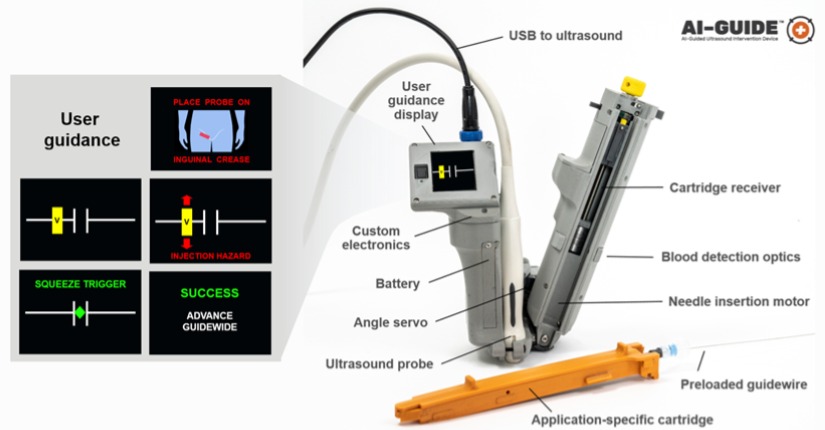
Enter AI-GUIDE: an award-winning technology that integrates custom AI software into a handheld ultrasound probe to help medical nonspecialists insert a needle or catheter into a blood vessel. Like a virtual librarian, AI can be trained on vast amounts of ultrasound data, so it can recognize and guide the user through complex anatomical structures. The result is a device that allows injured soldiers to receive immediate and accurate care when proper equipment is not available.
Scientists developed AI-GUIDE through a partnership between MIT Lincoln Laboratory (MIT LL) and the Massachusetts General Hospital (MGH) Center for Ultrasound Research and Translation in response to a request from the Defense Health Agency Combat Casualty Care Research Program. As the technology developed, the MIT Technology Licensing Office and the Lincoln Laboratory Technology Transfer Office supported the technology transfer process through a variety of mechanisms, most notably an AFWERX Small Business Innovation Research (SBIR) grant for the startup. This catalyzed the growth of AI-GUIDE from idea to proof of concept to startup — all within three years.
The startup, called AutonomUS Medical Technologies, gained additional investor funding from the DoW and the National Institutes of Health (NIH). In addition, AutonomUS won a Food & Drug Administration Breakthrough Device designation, which puts medical technologies that have potential for high impact on a "fast-track" review process. In other words, AI-GUIDE can be developed quickly because of its significant ability for speedy treatment.
Today, AI-GUIDE is a model example of how to take military innovation from concept to operational capability. The MIT LL Technology Transfer Office (TTO) team is still continuing research on new AI-GUIDE applications and how to transfer them to AutonomUS. For example, MIT LL/TTO has already transferred much of the work on vascular access and is also exploring nerve-block technology.
In addition, the technology transfer process has provided the MIT LL and MGH teams insights into the civilian medical industry so that the technology is not just a guide to blood vessels, but also a vessel for collaboration between AI and medicine. When familiar equipment and expertise is miles away and half the battle is beating the clock, technologies like AI-GUIDE can save the lives of soldiers and civilians in need.
Click on any images below to view larger versions and photo captions.