EcoFite: A Microbial Platform for Resilient Crop Performance
EcoFite: A Microbial Platform for Resilient Crop Performance
Farmers facing declining soil quality, water scarcity, and rising input costs may benefit from EcoFite, a microbial plant treatment developed at Los Alamos National Laboratory and selected for the laboratory’s 2025 Next Big Idea honor.
EcoFite combines naturally occurring beneficial microbes that colonize plants when applied to seeds or leaves. The microbes help crops absorb nutrients more efficiently, develop stronger root systems, and activate natural defenses against environmental stresses, including drought and soil salinity.
Unlike agricultural treatments that address a single challenge, EcoFite works through multiple biological pathways. It can be applied as a seed coating or foliar spray (a spray applied directly to leaves), is compatible with organic production systems, and can be used across different soil types, hydroponic systems, and crop species in greenhouse and open-field settings.
Greenhouse and field trials involving lettuce, tomatoes, and sorghum in Northern New Mexico and West Texas have demonstrated improvements in root growth, yield, and tolerance to environmental stress.
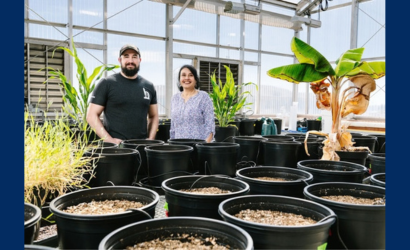
The technology was designed to help plants perform more reliably under varying growing conditions, according to Sangeeta Negi of the EcoFite team. By combining multiple beneficial microbes into a single formulation, the researchers aim to improve plant performance and resilience across diverse crops and environments.
EcoFite is backed by disclosed intellectual property developed at Los Alamos, including patent applications covering its microbial formulation and design approach. The laboratory is seeking commercial partners to scale production, expand field validation, and bring the technology to market through seed companies, agricultural input providers, and specialty crop producers.
If commercialized successfully, EcoFite could help growers improve crop productivity, manage resource constraints, and reduce input costs while supporting broader efforts to strengthen agricultural supply chains and long-term food production.
Originally published in the 2025 Annual Report for Los Alamos National Laboratory’s Richard P. Feynman Center for Innovation.