Unlocking New Water Resources — Dimethyl Ether Desalination System
THE PROBLEM: Brackish groundwater — found in coastal aquifers when seawater mixes with fresh water and in inland aquifers with high mineral dissolution — is one of the largest untapped water resources in the western U.S. because its high mineral content makes it difficult and costly to purify. Conventional desalination technologies rely on energy-intensive reverse osmosis processes that create concentrated brine waste, requiring specialized and expensive disposal.
THE SOLUTION: Idaho National Laboratory (INL) researchers developed a new approach to desalination that dramatically reduces the energy required to purify brackish water while minimizing waste. The Dimethyl Ether Desalination System works by introducing dimethyl ether into brackish water. Dimethyl ether reduces the solubility of dissolved salts, causing them to precipitate out earlier in the purification process. The water is cleaner by the time it reaches the reverse osmosis stage, where it’s pushed through a filter-like membrane. Cleaner water requires less energy to move through membranes and reduces fouling. Because less water remains trapped in the concentrate, disposal becomes far simpler and, in some cases, the mineral-rich residue can be repurposed for agricultural or industrial purposes.
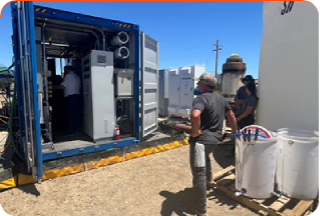
THE TECH TRANSFER MECHANISM: This process of dimethyl ether for desalination was developed through applied research funded by the Department of Energy. In 2023, INL entered into a license agreement with Trevi Systems, a California-based water treatment company specializing in high-efficiency desalination. INL provided Trevi with process data, analytical models, and system design support throughout the process to streamline development. A pilot system was then developed by Trevi and funded by the National Alliance for Water Innovation and the State of California. The pilot system was housed in a transportable container installed in a pistachio orchard to treat local brackish groundwater and produce clean irrigation water with minimal waste. INL and Trevi ensured that the technology addressed real-world needs while remaining economically viable by engaging farmers, municipal water providers, and others early in the process. This process took less than three years from idea to commercial solution, thanks to the strong partnership between INL and Trevi.
THE IMPACT: The Dimethyl Ether Desalination System has the potential to transform how the United States — and, ultimately, the world — produces freshwater from non-traditional sources. With droughts affecting over one-third of U.S. counties in the past decade, sustainable water treatment technologies are vital for food security, industrial productivity, and community resilience. INL’s technology addresses this challenge by offering a lower-cost, lower-energy, and lower-waste alternative to conventional desalination. Early pilot results in Coalinga, California, show that the system effectively removes minerals from brackish groundwater. The pilot produced clean irrigation water for crops like pistachios and simplified the waste disposal. The technology is modular, compact enough to fit inside a shipping container, and compatible with existing infrastructure, making it ideal for agricultural, municipal, and remote community applications.
Click on any images below to view larger versions and photo captions.