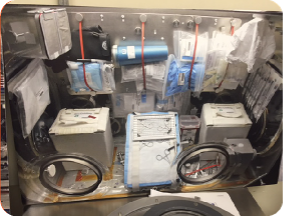
First Animal Survival Surgery in Space Advances Human Health Research
THE PROBLEM: Spaceflight has a detrimental effect on astronauts’ skin, which acts as the body’s first line of defense against injury and is essential for regulating temperature and fluid balance. Astronauts experience accelerated aging, disrupted circadian rhythm, abnormal thinning of skin and other atypical changes that could pose health risks. As deep-space missions become more frequent, the National Aeronautics and Space Administration (NASA) Rodent Research program called upon the Walter Reed Army Institute of Research (WRAIR) to study how microgravity affects the healing of skin wounds by training astronauts to perform animal surgeries aboard the International Space Station (ISS).
THE SOLUTION: The ISS Program Office required a demonstration experiment, so the WRAIR scientists collaborated with the Medstar Health Research Institute (MHRI) at Washington, D.C., to develop Rodent Research-DEMO 1 (RR-D1), “Protocol Demonstration and Validation for Effects of Spaceflight on Tissue Regeneration.” Together, they developed a ground training program that included practical exercises and instructional videos, and they used this program to train the mission astronauts in the protocols and procedures. The team prepared guidance based on the outcomes of the training program and transferred the technology to NASA for future use. During the August 2021 ISS mission, MHRI personnel were stationed at the Kennedy Space Center to monitor the procedure and provide live feedback to the astronauts as they successfully performed survival wounding operations on mice.
THE TECH TRANSFER MECHANISM: The Integrative Systems Biology branch of WRAIR’s Center for Military Psychiatry and Neuroscience specializes in systems-based solutions for military-relevant health performance, resilience and readiness. Experts at MHRI developed the surgery protocols and monitored the project in real time to assist the astronauts. The Department of War Space Test Program oversaw the scope, planning, execution and control of the project. The WRAIR/MHRI team successfully transferred the technical knowledge gained through RR-D1 to NASA, which then delivered it to the ISS as a critical knowledge product to be used in future space missions.
THE IMPACT: RR-D1 was the first survival surgery ever performed on the ISS. Under the protocol, mice remained alive and healthy for more than two weeks before being humanely euthanized. The results from the RR-D1 project were used to support the design of a subsequent study, Rodent Research-22 (RR-22). During the RR-22 study in July 2022, ISS astronauts performed successful survival surgeries on nearly 30 mice. The interagency partnership, technology transfer and ongoing investigative efforts of RR-D1 have helped scientists develop a better understanding of the effects of spaceflight stressors on wound healing, provided insights into improving astronaut health, and contributed to improved therapeutic approaches on Earth. To date, more than 10 national and international research presentations have described RR-D1’s achievements.
Click on any images below to view larger versions and photo captions.