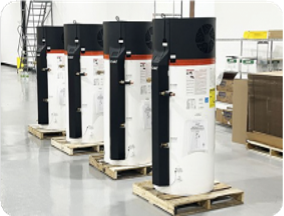
Commercialization of Intelligent Residential Heat Pump Water Heaters
THE PROBLEM: Water heating accounts for roughly 15-20% of residential energy use. While heat pump water heaters are more efficient than conventional systems, many still rely on reactive controls, leading to suboptimal energy use and inconsistent hot water availability.
THE SOLUTION: Scientists at the National Laboratory of the Rockies (NLR) developed advanced control technology to optimize water heating based on household usage patterns and external signals, such as electricity pricing. Cala Systems licensed this technology to develop an intelligent heat pump water heater that plans ahead — improving efficiency, ensuring ample hot water, and enabling the system to act as a flexible thermal storage resource that adjusts to grid demands.
THE TECH TRANSFER MECHANISM: In 2020, Cala secured an option agreement for NLR’s Model Predictive Control (MPC) of Water Heaters portfolio. After meeting diligence milestones and securing state support, Cala executed patent and software licenses in 2022. Cala collaborated with NLR through the NLR Technical Assistance Program and raised a $5.6 million seed round in 2024 to support commercialization.
THE TECH TRANSFER EXCELLENCE: Cala identified the opportunity through a Department of Energy Lab Partnering Service listing and combined federal lab innovation with state funding and regional ecosystem support to bring the technology to market more quickly.
THE IMPACT: Cala publicly launched its product in 2024 and began installations in the fall of 2025. Cala estimates that a typical home could save up to $865 annually on utility bills with its technology, translating to $24 billion in savings each year throughout the U.S. The technology can unlock an additional $10 billion in savings annually from fully utilizing water heating flexibility nationally.
Click on any images below to view larger versions and photo captions.