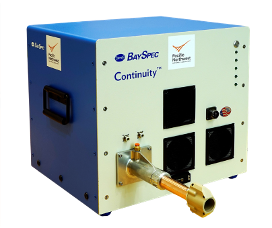
VaporID: Portable, Rapid, Non-Contact Detection of Fentanyl and Drug Vapors
THE PROBLEM: Illicit substances like fentanyl threaten national security and human safety at borders and in highly populated places, but they are challenging to detect because their low vapor pressure make it hard to sense in the presence of other vapors like perfumes and fuels. Typical technologies detect harmful chemicals by using contact sampling for particles and residues, which is intrusive, time-consuming, and damaging to the flow of commerce. Ensuring that they can be quickly and effectively identified is essential to improving security.
THE SOLUTION: Pacific Northwest National Laboratory (PNNL) developed VaporID to identify vapors at trace levels previously undetectable by any other technology. Detection takes merely seconds and is significantly faster, more accurate, and more sensitive than manual particle and residue collection. As a result, VaporID provides real-time, non-contact vapor detection of fentanyl and other dangerous chemicals without disrupting the flow of passengers, baggage screening, cargo, mail, and more. PNNL’s partner, BaySpec, developed a portable form of VaporID to take to market, allowing real-time detection of illicit materials that can cost thousands of lives each year. Once the size of a refrigerator, VaporID has been commercialized into a product weighing less than 50 pounds, about the size of a microwave oven, but still can sense the faintest wisp of fentanyl within seconds. VaporID, importantly, can also detect fentanyl analogs, or substances that are very similar but tweaked slightly in an attempt to avoid detection.
THE TECH TRANSFER MECHANISM: This transfer was over a decade in the making, culminating in a strategic partnership with BaySpec around 2021. VaporID was first developed in response to the 9/11 attacks, when an urgency for explosives screening became apparent in the United States. Industry began engaging with VaporID in 2015 and, in 2021, PNNL’s Technology Commercialization Office funded work to reduce the size and cost of VaporID. PNNL scientists participated in the Department of Homeland Security Science and Technology Directorate’s Commercialization Accelerator Program on several occasions, finally matching with BaySpec to integrate components of the new technology and demonstrate its ability to detect drugs and explosives at security-grade sensitivity. In 2023, BaySpec obtained a license to manufacture and sell VaporID instruments through a non-exclusive license.
THE TECH TRANSFER EXCELLENCE: After several years and partnerships that didn’t quite produce an appropriately sized, priced, or sensitive device, PNNL matched with BaySpec on the advice of a Department of War program manager. Once introductions were made, a non-disclosure agreement was quickly signed, funding was secured, and a license obtained. It took only a month for PNNL and BaySpec to negotiate a non-exclusive license for VaporID in 2023.
THE IMPACT: VaporID has delivered on a critical national security need that will have a great impact on the American public. The technology was named GeekWire’s 2020 Innovation of the Year and received the R&D 100 Awards Gold Medal as a Market Disruptor in 2019. VaporID achieved contactless, real-time fentanyl detection at one of the nation’s busiest border crossings and a demonstration at the largest conference for trace explosive detection in Ireland, earning international headlines. From an origin crafted in the wake of national tragedy, PNNL and BaySpec have advanced VaporID to a niche in the fight against the scourge of illicit fentanyl.
Click on any images below to view larger versions and photo captions.