AI-Enabled Breakthrough Expands Lifesaving Care on the Battlefield and Beyond
THE PROBLEM: The objective of the “golden hour” policy at the Department of War (DoW) is to ensure that wounded soldiers receive surgical intervention within an hour of injury. However, in situations where immediate hospital evacuation is not possible, field medics often have to care for injured soldiers in the field for days without access to the specialty expertise or equipment required to perform lifesaving procedures, such as fluid resuscitation and endovascular intervention.
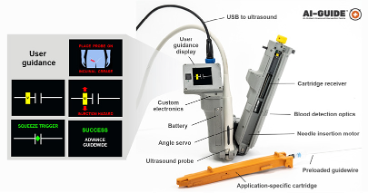
THE SOLUTION: AI-GUIDE is a technology that integrates commercial handheld ultrasound technology with custom AI software to help medical nonspecialists accurately insert a needle into a blood vessel and allow the placement of catheters for lifesaving care. The technology was created through a partnership between MIT Lincoln Laboratory (MIT LL) and clinicians at the Massachusetts General Hospital (MGH) Center for Ultrasound Research & Translation, in response to a directive and funding from the Defense Health Agency Combat Casualty Care Research Portfolio (CCC). Testing has proven that the AI-GUIDE prototype is fast and accurate when used by nonspecialists, earning it a Lincoln Laboratory Best Invention Award and an R&D 100 Award. By expanding access to care in austere environments, AI-GUIDE promises to save lives and improve outcomes for warfighters and civilians.
THE TECH TRANSFER MECHANISM: The MIT Technology Licensing Office and the Lincoln Laboratory Technology Transfer Office use a variety of technology transfer mechanisms, along with support from the CCC, an AFWERX Small Business Innovation Research (SBIR) grant, and private investor funding secured by AutonomUS Medical Technologies, a startup cofounded by MGH and MIT LL team members. They collaborate to transfer the AI-GUIDE technology, research and development insights, and clinical study results as they are developed. Much of the more mature work for vascular access has been transferred. Nerve-block technologies and others in development will be transferred as their efficacy is proven.
THE TECH TRANSFER EXCELLENCE: The MIT LL/MGH team developed an advanced medical technology from idea, to working proof of concept, to startup company within three years. They supported the startup company as it secured a Food & Drug Administration (FDA) Breakthrough Device designation and private investment and funding from the DoW and the National Institutes of Health (NIH). The strong connection with MIT LL and its Technology Transfer Office enables the team to continue researching new AI-GUIDE applications, test them with MGH partners, and transfer them to AutonomUS, establishing a translational pathway for future technologies.
THE IMPACT: Through the AI-GUIDE technology transfer process, the MIT LL and MGH teams have gained insights into the nonmilitary medical industry and have refined AI-GUIDE’s specifications through interactions with the FDA and potential customers. SBIR grant funding has enabled the team to mature the technology and transfer it to AutonomUS, boosting the startup’s growth. With substantial support from NIH, AI-GUIDE will be introduced to the civilian medical market, which will be crucial for its economic viability. Furthermore, the collaboration among MIT LL, MGH, and AutonomUS is a model example of how to progress a military innovation from concept to operational capability, establishing a framework for future collaborations.
Click on any images below to view larger versions and photo captions.