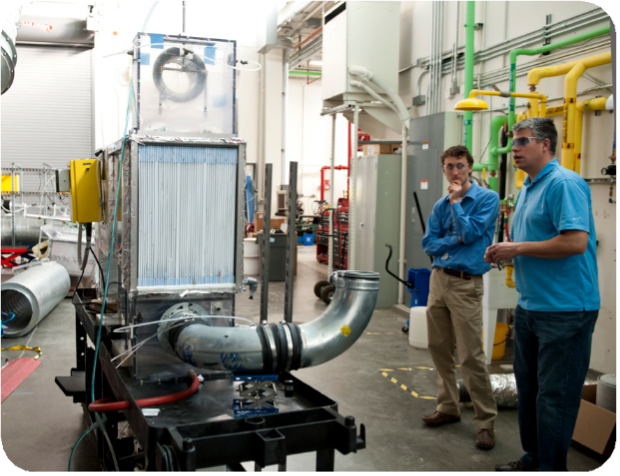
NLR’s Groundbreaking Energy Storing and Efficient Air Conditioner
THE PROBLEM: Air conditioning is essential for maintaining comfortable, healthy temperatures in homes, schools, workplaces, and community spaces — but the technology is outdated, expensive, and environmentally harmful. By 2050, global air-conditioning use is expected to climb to five times what it is today. Every year, air conditioners cost Americans more than $29 billion in household energy costs. Many older air conditioning systems use refrigerants harmful to the environment, and the high energy demand can strain the electric grid, increasing costs for utilities and, ultimately, consumers.
THE SOLUTION: The Energy Storing and Efficient Air Conditioner (ESEAC) technology from the National Laboratory of the Rockies (NLR, formerly National Renewable Energy Laboratory) uses a liquid desiccant system that absorbs humidity directly from the air, requiring significantly less electricity and reducing operating costs. Additionally, ESEAC incorporates built-in energy storage, allowing it to consume far less electricity from the grid during peak times. By separating cooling and dehumidification from real-time electricity use, ESEAC provides a more grid-friendly alternative to conventional air conditioning at a much lower cost. ESEAC’s technology can cut electricity use for indoor cooling by up to 50%, while its integrated storage system could reduce peak demand by more than 90%.
THE TECH TRANSFER MECHANISM: In 2018, NLR and the startup Blue Frontier pursued a license agreement with key diligence milestones tied to capital raising, prototype development, and manufacturing obligations. Two years in, Blue Frontier received funding from Wells Fargo & Co. and the Department of Energy to continue ESEAC development and test prototype systems. In 2024, commercial real estate giant CBRE selected Blue Frontier to pilot ESEAC technology.
THE TECH TRANSFER EXCELLENCE: It took a highly collaborative, multi-year effort among federal researchers, licensing professionals, private entrepreneurs, and corporate partners to achieve this technology transfer. Overall, the license was amended five times to accommodate the company’s growth, 22 patents were secured, and nearly $3 million in joint project funding was developed. It was a dynamic, collaborative process that aligned public innovation with private execution to enable a breakthrough technology to impact the market.
THE IMPACT: ESEAC is a revolutionary cooling technology that combines cooling, dehumidification, and energy storage into one efficient system. Its design separates cooling and dehumidifying in the air conditioning process and features built-in energy storage — cutting electricity use by up to 50%, reducing peak energy demand by up to 90% or more, and easing strain on the grid. Since teaming up with NLR on this project, Blue Frontier has raised over $47 million in investment funds and expects to grow its staff, facilities, and research and development capabilities. Based on analyses of prototypes in Miami, the ESEAC system could save customers more than $165,000 each over its 15-year expected lifespan. That analysis is supported by trials at Fort Benning in Georgia, Bank of America branch offices in Delaware, an IMAX theater in Florida, and several grocery stores in California.
Click on any images below to view larger versions and photo captions.