LanPure: Next-Generation Separation Technology Reduces Environmental Impact of Rare Earth Processing
THE PROBLEM: Smartphones, electric vehicles, laptops, tablets, and other ubiquitous tech — not to mention data centers, wind turbines, and defense systems — rely on vital rare earth elements (REEs) for their production. However, REEs are difficult and costly to obtain, and traditional methods for purifying them are either small-scale and slow-moving, or large-scale but inefficient and polluting. REEs are largely imported, with China controlling over 95% of REE refining. This creates a significant bottleneck in the supply chain and places the United States in a vulnerable geopolitical position.
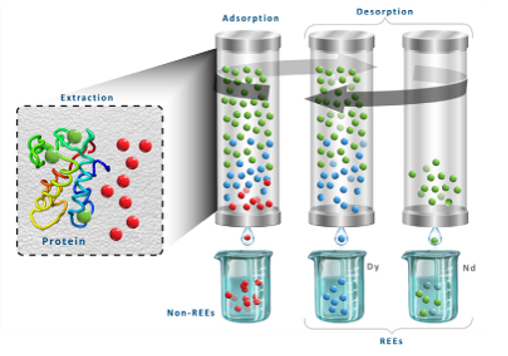
THE SOLUTION: Lawrence Livermore National Laboratory (LLNL) developed a groundbreaking technology called Lanmodulin-Based Rare Earth Purification (LanPure), which enables highly selective extraction and separation of REEs from diverse sources, including rare earth ores, mining waste, coal byproducts, and recycled electronics. The technology addresses purification and supply chain challenges by using proteins called lanmodulins, first discovered in bacteria, to separate the REEs. The lanmodulins can recognize and bind to specific REEs, even when present in trace amounts and mixed with other metal ions. LanPure is notable for its selectivity, speed, reusability, and sustainability. It is a highly durable system that allows for thousands of reuse cycles without loss of performance, lowering operational costs. It also could support increased domestic extraction of critical materials, reducing reliance on foreign supply chains.
THE TECH TRANSFER MECHANISM: The lanmodulin protein was discovered in 2018 by a team of researchers at Pennsylvania State University. Shortly thereafter, LLNL scientists leveraged the protein’s strong ability to bind and select REEs to create a new biomining technology, which yielded LanPure, an intellectual property related to the industrial use of the natural and engineered lanmodulin proteins. Technology transfer efforts were supported through two federal programs: the Critical Materials Innovation Hub, an Iowa-based Department of Energy research center focused on ensuring American technological competitiveness through efficient use of domestic materials; and the Department of War’s (DoW) Defense Advanced Research Projects Agency’s EMBER (Environmental Microbes as a BioEngineering Resource) program. To pursue technology commercialization, LLNL identified a licensing partner in Alta Resource Technologies, a Colorado-based company that applies biochemical techniques to critical mineral separation.
THE TECH TRANSFER EXCELLENCE: The LLNL Innovation and Partnerships Office determined that Alta was well positioned to advance LanPure technology through the commercialization process. Alta obtained encouraging test results on LanPure’s efficiency, reusability, and commercial viability. After opting into an exclusive licensing agreement within a defined field of use for technology development, Alta and LLNL worked closely to scale the technology, and the collaboration successfully raised three funding rounds during the licensing period.
THE IMPACT: By building a strong and sustainable REE supply chain domestically, U.S. manufacturing could reduce its reliance on imported resources. At the time of publication, Alta had raised more than $10 million in seed funding to pursue commercialization of the biobased separation method. Shovel-ready commercialization of the LanPure process is slated for mid-2027. In partnership with the DoW, Alta will bring commercial production online in 2027. Most importantly, Alta has demonstrated multiple REE separations at high purity levels and high yield in a single column run, proving the technology’s effectiveness.
Click on any images below to view larger versions and photo captions.