A Clearer Picture: New Technology Reduces Damage in Electron Microscopy
Electron microscopes allow scientists to examine materials at an incredibly small scale, opening the door to discoveries in fields ranging from drug development and energy storage to semiconductor manufacturing. But these powerful tools have a significant limitation: The electron beams used to capture images can damage the very materials researchers are trying to study. That damage can alter a sample’s properties before an image is even captured, making it difficult or impossible to examine delicate biological materials, living systems, and other sensitive substances at the molecular level needed to unlock breakthrough discoveries that fuel future innovations.
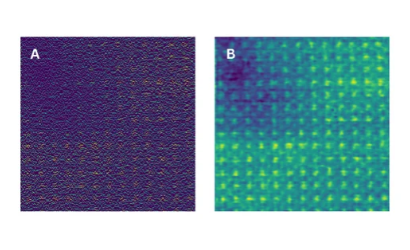
Pacific Northwest National Laboratory (PNNL) developed a compressive sensing technology that could improve how imaging devices capture and process information. The technology allows electron microscopes to produce high-quality images up to 100 times faster while causing just 1% of the material damage associated with conventional imaging approaches. And it does so without sacrificing image quality.
The technology’s potential extends well beyond electron microscopy. Its plug-and-play design works with almost any imaging device, upgrading existing tools without requiring researchers to buy new equipment.
PNNL’s technology first entered the commercial arena in 2019, when the laboratory began licensing discussions with Sivananthan Laboratories to explore applications in night vision and other defense technologies. Nuxutra, a Sivananthan subsidiary, subsequently received an exclusive license to use the technology in night vision camera detectors.
The technology’s possibilities expanded in 2022, when researchers at the University of Liverpool (UoL) recognized that it could be applied to a much broader range of imaging devices. The university team partnered with Nuxutra, and the collaboration secured several Small Business Innovation Research Phase I and Phase II awards from the Department of Energy and the National Aeronautics and Space Administration. The projects led to new camera designs and patents for Nuxutra, while UoL secured patents covering additional applications.
Recognizing the potential of combining their intellectual property and expertise, Nuxutra and UoL brought their assets together under a new company, SenseAI Vision, to advance the technology’s commercial development.
Bringing the partnership together required careful coordination across multiple organizations and intellectual property portfolios. Each party had to disclose its relevant technologies and demonstrate their maturity so the partners could fairly assess ownership and royalty arrangements. The organizations also had to work through competing interests and recognize the greater commercial potential of combining their assets. Because the technology transfer involved both U.S. and U.K. intellectual property, SenseAI also had to demonstrate economic benefits in both countries.
The resulting venture is developing AI-driven compressive sensing software designed to improve electron microscopy and other analytical imaging systems. In several U.K. case studies, SenseAI’s software has helped research institutions speed up analysis, address data management challenges, increase processing capabilities, and reduce damage to delicate samples.
By making advanced imaging faster and less destructive, the technology could give researchers access to materials and processes that were previously difficult to study. From medical research and materials science to engineering and semiconductor development, the possibilities are significant. What began as a technology developed for defense applications has evolved into a tool with the potential to change how scientists see, understand, and explore the world at the smallest scales.
Click on any images below to view larger versions and photo captions.