Where Are They Now? CERL’s BUILDER Sustainment Management System
Military installations function like small cities. These bases and stations include thousands of buildings, roads, utility systems, warehouses, and other facilities that must remain safe and operational to support military readiness. For many years, facility managers often relied on scattered data and reactive maintenance — fixing roofs, heating and cooling systems, electrical equipment, and other building components only after problems became costly or disruptive. As military infrastructure aged and maintenance budgets tightened, the Department of War (DoW) needed a better way to decide where limited resources would have the greatest impact.
Researchers at the U.S. Army Corps of Engineers’ Construction Engineering Research Laboratory (CERL) answered that challenge by developing the BUILDER Sustainment Management System. Instead of treating each repair as an isolated project, BUILDER gave facility managers a way to evaluate the condition of building components, forecast future deterioration over time, and prioritize repairs before failures occurred. The BUILDER system rated each component’s condition on a 100-point scale, making it easier to understand the health of a facility and determine where limited maintenance funding would have the greatest impact.
The system quickly proved its value. After the U.S. Marine Corps implemented the system across its installations, BUILDER demonstrated that a standardized approach to facility condition assessments could improve long-term infrastructure planning. In 2013, the BUILDER methodology became the enterprise standard for assessing facility conditions across the Army, Navy, Air Force, and Marine Corps. For the first time, leaders could compare facilities using a common set of measures and make more informed decisions about billions of dollars in maintenance and restoration investments. By late 2019, BUILDER — which also received a 2010 FLC Excellence in Technology Transfer Award — had been used to assess billions of square feet of federal facilities.
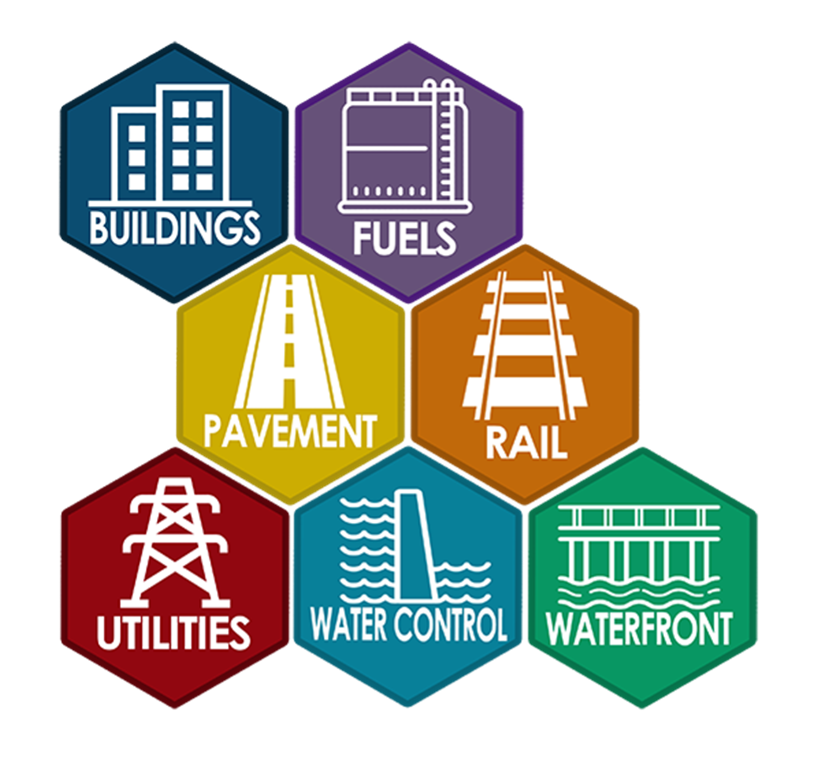
As successful as BUILDER was, the technology landscape continued to evolve. Facility managers often had to switch between separate systems to manage buildings, pavements, fuel infrastructure, and railroads, making it difficult to understand the overall condition of an installation or balance competing priorities. Meanwhile, advances in cloud computing, mapping technology, and data analytics opened new opportunities to modernize infrastructure management.
Those advances led to the Enterprise Sustainment Management System, or E-SMS. Rather than replacing BUILDER, E-SMS builds on it by bringing multiple core infrastructure functions together in a single cloud-based platform. E-SMS combines facility condition information with interactive maps, advanced analytics, and enterprise reporting tools. Together, this gives decision-makers a more complete picture of infrastructure risks and helps them prioritize investments across an entire installation.
The E-SMS Buildings domain now performs much of the work once handled by BUILDER, while adding cloud-based accessibility and stronger data integration capabilities. Across the DoW, organizations are migrating decades of historical records and daily workflows into the new system. Legacy Builder platforms will remain operational through Aug. 1, 2026, allowing the transition to occur without disrupting day-to-day operations or losing valuable data.
The journey from BUILDER to E-SMS illustrates how a research innovation matured into an enterprise-wide capability. What began at CERL as a tool for assessing building conditions has evolved into the foundation of the DoW’s modern infrastructure management strategy. Most service members will never notice the software working behind the scenes, but they benefit from it every day. By helping leaders make smarter investment decisions, reduce life cycle costs, and mange more than 2.3 billion square feet of military facilities, E-SMS helps ensure the infrastructure supporting training, operations, and national defense remain ready for the missions ahead.
Click on any images below to view larger versions and photo captions.