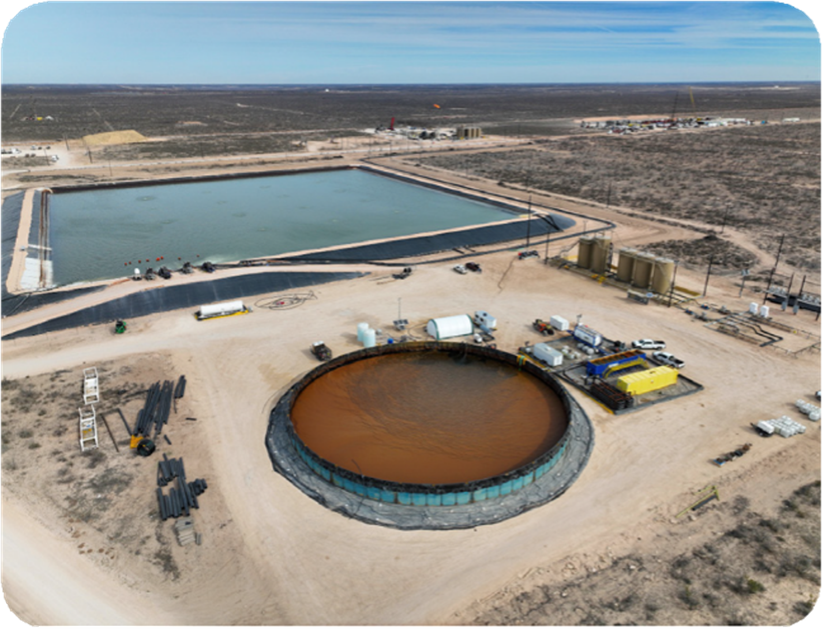
From Oilfield Waste to a Domestic Source of Lithium
What if one of the biggest challenges facing the U.S. battery industry could be addressed by something the oil and gas industry has been trying to get rid of for decades? That is the idea behind a partnership between Oak Ridge National Laboratory (ORNL) and Texas-based Element3, which is working to recover lithium from the vast amounts of wastewater produced during oil and gas operations.
Lithium has become increasingly important to the U.S. economy and national security. It is a key ingredient in the batteries used in electric vehicles, energy storage systems, communications equipment, and other technologies. But the United States produces only a small fraction of the lithium it needs, leaving the country heavily dependent on imports and vulnerable to disruptions in the global supply chain.
At the same time, producing oil creates an enormous amount of wastewater. For every million barrels of oil extracted, roughly 4 million barrels of produced water can be generated. This water contains a complicated mixture of brine, injected water, and other contaminants — but it can also contain lithium.
Element3 saw an opportunity to turn that waste into something valuable. What the company needed was a way to efficiently separate the lithium from everything else. ORNL had some of the pieces needed to make that possible.
The laboratory had developed technologies for extraction, concentration, selective absorption, and separation for other applications. Working with Element3, ORNL recognized that the technologies could be adapted to recover lithium from oil and gas wastewater.
The two organizations began exploring the opportunity in 2021, when they signed a nondisclosure agreement. ORNL subsequently filed patents covering seven technologies between 2021 and 2023. Together, the technologies address the different steps needed to extract, concentrate, purify, and separate lithium to produce a battery-grade material.
The partners developed an expedited licensing strategy and completed a commercial license agreement in 2025, giving Element3 access to the full suite of technologies needed to advance its process.
In a demonstration, Element3 recovered more than 85% of the lithium from wastewater containing less than 40 parts per million of the mineral. Independent testing also confirmed that the recovered material met battery-grade standards.
The United States has not opened a new domestic lithium production facility in nearly 60 years, even as demand for the mineral is expected to soar. By 2030, U.S. battery plants are projected to require roughly 40 times the country’s current lithium production, while domestic production is expected to satisfy only about one-quarter of that demand.
Recovering lithium from wastewater offers something increasingly valuable: another domestic source of a critical mineral, using a resource that is already being produced in enormous quantities.
For ORNL, the partnership also illustrates the unexpected paths federal laboratory research can take. Technologies developed for one purpose can find entirely new applications when the right industry partner comes along. In this case, that meant looking at oilfield wastewater a little differently — as a potential source of one of the most important materials in the energy economy.
This technology received a 2026 FLC Excellence in Technology Transfer Award. Learn more here and discover more awardees in our Awards Gallery.
Click on any images below to view larger versions and photo captions.
Click on any images below to view larger versions and photo captions.