Innovative Demonstration Proves Effective for U.S. Coast Guard on Maritime Smuggling Routes
The U.S. Coast Guard (USCG) and other federal border security agencies are charged with protecting the mainland U.S. from dangerous threats like drug and human trafficking. One 3,200-square-mile region of ocean between Puerto Rico and the Dominican Republic known as the Mona Passage is especially exposed to trafficking.
The USCG monitors the Mona Passage to protect millions of people from violent maritime activity. But engaging with a suspicious vessel is risky for Coast Guard personnel, who often have limited information regarding potentially dangerous people or items on board.
Maritime Domain Awareness (MDA) data – which creates a comprehensive report of all conditions in the global maritime environment – is reliable but often consumes massive resources to gather and is preferred for higher-priority missions.
To reduce the risk to Coast Guard personnel and increase the speed, accuracy, and breadth of MDA intelligence, the USCG Research and Development Center (RDC) devised a rapid technology transfer testbed that integrated remote sensing, networking, and data transport technologies to provide the USCG with more safety information during their missions.
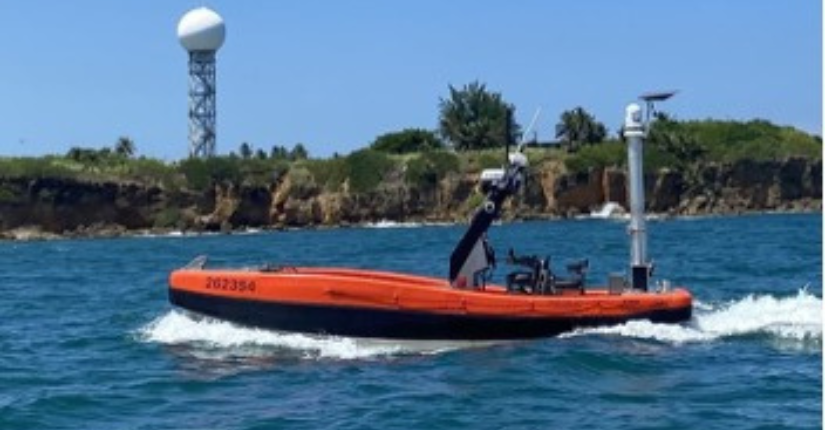
The RDC first deployed two uncrewed surface vessels and two uncrewed aircraft systems throughout the Mona Passage. Using advanced cameras and sensors, the ships and drones provided unprecedented visuals and access to high-risk areas, which significantly improved MDA capabilities for USCG personnel. They relayed critical intelligence to the USCG and Customs and Border Protection (CBP) command centers, which allowed for more efficient decision-making and faster response.
They called this month-long test case “Operational Demonstration COQUI.” Significantly less illicit activity was recorded in the Mona Passage during RDC’s demonstration, and CBP reported that the technology disrupted smuggling efforts so effectively that agents could intervene with greater confidence, leading to several arrests.
The innovation behind the research was a multi-year process that required expertise and collaboration across virtually all RDC program areas: Autonomy, Connectivity, Waterways Management & Response, and Integration, Experimentation, & Transition.
As of early 2026, the technology transfer effort is still underway, with the RDC, CBP partners, and Caribbean-based Coast Guard developing another phase of regional deployments.
COQUI was so effective that regional teams have redesigned aspects of their own large-scale enforcement operations to better incorporate the technologies it featured. Overall, the technology and processes developed by the RDC team will contribute to improving the USCG’s MDA capabilities, while addressing major enforcement mission needs and balancing cost, risk, and overall practicality.
This innovation has helped the USCG intercept dangerous drugs and activities before they get to our borders.
This technology received the 2025 Regional Technology Transfer Award for the Northeast Region. Learn more here and discover more awardees in our Awards Gallery.
Click on any images below to view larger versions and photo captions.