A Protein-Powered Solution to America’s Rare Earth Challenge
From smartphones and laptops to electric vehicles and wind turbines, many of the technologies Americans rely on every day depend on rare earth elements (REEs). These critical materials are also essential to data centers and national defense technologies, yet they can be difficult and expensive to extract and purify. The challenge extends beyond mining: China controls more than 90% of the global REE market, leaving the United States vulnerable to disruptions in a supply chain essential to its economy and national security.
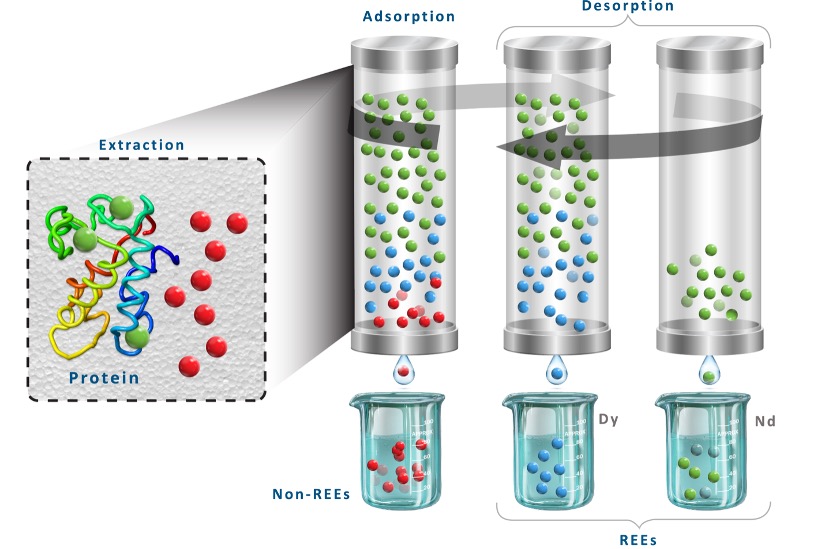
The technology builds on the discovery of lanmodulins, proteins first identified in bacteria by researchers at Pennsylvania State University (Penn State) in 2018. These proteins have a remarkable ability to recognize and bind to specific REEs, even when those elements are present in trace amounts among other metals. Recognizing the potential of lanmodulins for mineral recovery, LLNL scientists co-developed a biomining technology with Penn State, called LanPure, that harnesses their selectivity for rare earth purification.
LanPure offers several potential advantages over conventional separation methods. Its highly selective proteins can isolate REEs from complex mixtures, while the system’s durability allows it to be reused thousands of times without losing performance. That reusability could reduce operating costs while supporting more efficient and sustainable recovery of critical materials from domestic sources.
Two federal initiatives helped support LanPure’s development and technology transfer: the Critical Materials Innovation Hub, a Department of Energy research center focused on strengthening U.S. technological competitiveness through the efficient use of domestic materials, and the Environmental Microbes as a BioEngineering Resource (EMBER) program, funded by the Defense Advanced Research Projects Agency within the Department of War.
To bring LanPure closer to commercial use, Alta Resource Technologies, a Colorado-based startup company, approached LLNL to license the technology. Alta specializes in applying biochemical techniques to separate critical minerals and saw potential in LanPure’s approach. Testing produced encouraging results for the technology’s efficiency, reusability, and commercial viability, paving the way for an exclusive licensing agreement. The partners have since worked to scale the technology, while Alta has raised three rounds of funding to advance commercialization.
The opportunity is significant. By making rare earth purification more selective, reusable, and sustainable, LanPure could help expand domestic production and reduce U.S. dependence on foreign suppliers. To date, Alta has raised more than $35 million from leading venture capital firms and has also received funding and support from the Defense Advanced Research Projects Agency (DARPA), the U.S. Department of Energy’s Critical Materials Innovation Hub and the State of Colorado.
The REEs inside the next phone, tablet, or electric vehicle may still come from a global supply chain. But technologies like LanPure offer a path toward a different future — one in which the United States can recover more of these essential materials at home, using innovative science to turn a supply chain vulnerability into an opportunity for domestic production. The next time you pick up your phone, drive an electric vehicle, or see a wind turbine turning in the distance, consider the REEs that make these technologies possible — and the global supply chain that delivers them.
With LanPure, LLNL and Alta are working to bring more of that supply chain home, helping ensure the materials behind tomorrow’s innovations can be sourced and processed right here in the United States.
This technology received a 2026 FLC Excellence in Technology Transfer Award. Learn more here and discover more awardees in our Awards Gallery.
Click on any images below to view larger versions and photo captions.